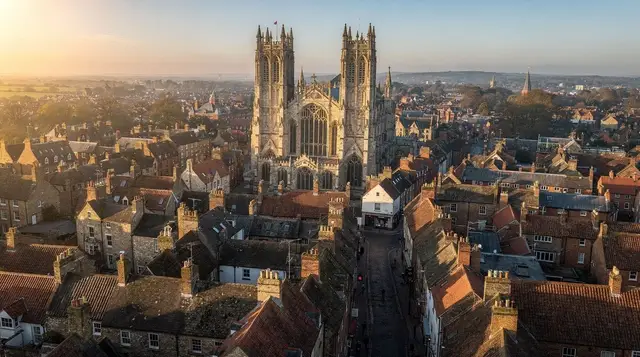
Whitby
The seaside town that inspired Dracula — abbey ruins, fish and chips, a working harbour, and how to see it as a day trip from York.
Quick facts
Top tours and experiences
We earn a small commission if you book through GetYourGuide or Viator — at no extra cost to you. Every tour is hand-picked and verified.


Whitby is a working fishing harbour with a ruined abbey on the clifftop above it, and it earns its reputation as one of the best day trips from York — provided you go with a plan, since the town is small enough that an unstructured wander burns through your visit faster than expected.
| Where | North Yorkshire coast, ~90 min from York by car |
| --- | --- |
| Time needed | 1 full day, or 2 with a moors detour |
| --- | --- |
| Cost | Abbey entry from around £13.50; fish and chips £10-£14 |
| --- | --- |
| Getting there | Car/coach (~90 min) or train with a change (~2hrs) |
| --- | --- |
| Best time | April-September for weather; late October for Goth Weekend |
Getting there from York
Whitby sits roughly 90 minutes from York by car via the A64 and A169, a route that cuts straight across the North York Moors and is scenic enough to be worth the drive on a clear day. By train, there’s no fully direct service — the journey typically involves a change, usually via Middlesbrough or Scarborough, and takes closer to two hours each way, which makes it a longer day than the driving time suggests. Coach tours and organised day trips run directly from York and are genuinely the easiest option if you don’t want to drive, often bundling in a stop at Goathland or a section of the North Yorkshire Moors Railway along the way.
See day trip to Whitby from York for a full transport breakdown.
Whitby Abbey
The ruined abbey on the East Cliff is Whitby’s defining landmark, visible from most of the town and from ships far out to sea. The current ruins date mostly from a 13th-century rebuild of an earlier Anglo-Saxon monastery founded in 657 AD, and it’s this Gothic silhouette — stark against the sky, especially at dusk — that reportedly caught Bram Stoker’s attention during an 1890 holiday in the town, feeding directly into Dracula. English Heritage manages the site now; entry runs about £13.50 for adults, and the visitor centre inside the adjacent Cholmley House does a solid job connecting the abbey’s monastic history to its literary afterlife.
Getting up to the abbey means climbing the famous 199 steps from the harbourside old town — a genuine workout, not a metaphor, so pace yourself or take the longer road route if steps are a problem.
Book Whitby Abbey entry ticketsA day trip from York, organised
If you’d rather not drive or deal with the train’s change of service, a guided day trip from York covers the transport and usually bundles in a stop at the abbey or the harbour, sometimes with the moors added on.
Book a Whitby and North York Moors day trip from YorkThe Dracula connection
Stoker set several key scenes of the novel in Whitby, and the town has leaned into the association hard — there’s a Dracula Experience attraction, several goth and gift shops along Church Street, and the town hosts Whitby Goth Weekend twice a year (spring and late October), when the streets fill with a genuinely striking mix of subculture fashion. Worth timing a visit around if that interests you, though accommodation books out well ahead for those weekends and prices rise accordingly.
The harbour and old town
Whitby remains a working fishing port, not just a preserved tourist set piece, and that distinction matters — the smell of the harbour, the actual fishing boats coming in, and the fish markets are real rather than staged. The old town on the west side of the harbour is a tangle of narrow streets (Church Street especially) lined with independent shops, jet jewellery stores (Whitby jet, a black gemstone historically mined locally, has been worked here since Roman times), and seafood spots. Crossing the swing bridge to the newer west-side town centre gets you standard high street shopping, less atmospheric but useful for practical needs.
Fish and chips, done properly
Whitby’s fish and chip reputation is largely earned — several long-running chippies here (the ongoing rivalry between the best-known names is a genuine local topic of debate) serve genuinely fresh catch, and eating a portion on the harbourside benches while gulls circle overhead is close to a mandatory Whitby experience. Expect £10-£14 for a sit-down portion, less for takeaway. Guard your chips; the local seagulls are experienced and fast.
Robin Hood’s Bay and the coast
If you have a car and extra time, Robin Hood’s Bay sits about 15 minutes south along the coast — a steep, quieter fishing village worth combining with Whitby on a longer day. The Cleveland Way coastal path runs along the clifftops in both directions from Whitby, and even a short section (toward Sandsend to the north, a flat and easy walk along the beach at low tide) gives good sea views without committing to a full hiking day. See Cleveland Way taster for manageable short sections.
Practical tips
Parking in the old town is limited, narrow, and expensive; most visitors use one of the larger pay car parks on the approach into town and walk the last stretch. Whitby gets genuinely busy on summer weekends and during Goth Weekend — arriving early beats the worst of both parking pressure and crowds around the abbey steps. Check tide times if you’re planning any beach walking, since parts of the shoreline (particularly toward Sandsend) are only comfortably walkable at low tide.
Captain Cook and Whitby’s maritime history
Beyond the Dracula connection, Whitby has a genuine claim to maritime significance: James Cook served his apprenticeship here in the 1740s aboard Whitby-built coal ships before his later voyages of exploration, and the town’s shipbuilding industry produced the very type of vessel — the Whitby collier — that Cook later chose for his own expeditions, including the Endeavour. The Captain Cook Memorial Museum, housed in the actual building where Cook lodged as an apprentice, covers this history in detail and is a worthwhile stop for anyone with an interest beyond the Gothic fiction angle.
A statue of Cook stands on the West Cliff, overlooking the harbour, alongside the distinctive whalebone arch — a reminder that Whitby was also a significant whaling port through the 18th and 19th centuries.
Whitby jet and local craft
Whitby jet — fossilised monkey puzzle tree wood, found in the cliffs and shale around the town — has been worked into jewellery here since at least Roman times, with a major revival during the Victorian era when Queen Victoria’s mourning jewellery popularised the deep black stone nationally. Several shops on Church Street still sell genuine Whitby jet pieces, distinguishable from imitation black glass or plastic by its light weight and warmth to the touch; genuine jet jewellers are generally happy to explain the difference if asked, which is a reasonable way to avoid paying jet prices for glass.
Combining Whitby with the moors
Many day trips from York pair Whitby with a stop in Goathland (the filming location for Aidensfield in Heartbeat and a Harry Potter station stand-in) or a ride on part of the North Yorkshire Moors Railway, a heritage steam line running through genuinely dramatic moorland scenery between Pickering and Whitby itself. If you’re planning a longer stay, the York, Whitby and Moors 3-day itinerary lays out a workable route combining all three.
Whitby with an overnight stay
While most visitors treat Whitby as a day trip from York, staying overnight changes the experience considerably — the town empties of coach parties by early evening, the abbey ruins are floodlit after dark (a genuinely striking sight from the harbourside), and an early-morning walk up the 199 steps before the day-trippers arrive gives a version of the town closer to how it feels to residents. Accommodation ranges from harbourside guesthouses to a scattering of larger hotels on the West Cliff, and prices rise noticeably around Goth Weekend and summer weekends, so booking ahead matters more here than it does for a straightforward day visit.
Whitby’s Captain Cook and Endeavour connection in more depth
The replica of Cook’s Endeavour that occasionally visits (and the Whitby-built collier design that inspired his real vessels) reflects a broader point about the town: its shipbuilding heritage was genuinely significant to British maritime history, not just a footnote to the Dracula and Goth Weekend associations that dominate modern marketing. Whitby-built ships were prized for their cargo capacity and sturdiness, built specifically for the coal trade between Newcastle and London, and it was exactly these qualities — plentiful storage and a shallow draught suited to uncharted waters — that made them Cook’s vessel of choice for voyages of exploration rather than the sleeker naval ships of the era.
Whether or not that maritime history interests you as much as the abbey and the fiction it inspired, it’s worth the ten minutes at the Cook museum to see the town’s history from a different angle than the one most day-trippers leave with.
Whitby by season
| Season | What it’s like |
|---|---|
| Spring | Mild, quieter than summer; Goth Weekend in April brings a short crowd spike |
| --- | --- |
| Summer | Busiest and warmest; best for beach time toward Sandsend, book parking early |
| --- | --- |
| Autumn | Fewer crowds, good coastal light, cooler for the 199 steps |
| --- | --- |
| Late October | Whitby Goth Weekend — atmospheric but book accommodation well ahead |
| --- | --- |
| Winter | Quiet and moody; some businesses reduce hours, abbey and harbour still open |
Frequently asked questions about Whitby
How long does it take to get to Whitby from York?
About 90 minutes by car or direct coach; closer to two hours by train, since there’s no direct rail route and a change is usually required.
Is Whitby Abbey worth the entry fee?
Yes for most visitors — the ruins, clifftop position, and the visitor centre’s Dracula and monastic history displays justify the roughly £13.50 adult ticket, especially combined with the walk up the 199 steps.
Can I visit Whitby without a car?
Yes, via train (with a change) or, more easily, an organised coach day trip from York, several of which include stops at Goathland or the moors railway.
Is one day enough to see Whitby properly?
For the abbey, harbour, old town and fish and chips, yes. If you want to add Robin Hood’s Bay or a proper walk along the Cleveland Way, two days works better.
When is Whitby Goth Weekend?
Twice yearly, in spring (April) and around Halloween (late October) — check exact dates ahead, since accommodation books up quickly and prices rise for both events.
Is Whitby touristy?
Parts of it, particularly Church Street’s gift shops and the Dracula-themed attractions, but the harbour remains a genuine working fishing port rather than a purely staged experience.