
Walking the York city walls: a practical guide
How long does it take to walk the full circuit of York's city walls and does it cost anything?
The full loop is around 2.5 miles and takes most people 90 minutes to 2 hours at a relaxed pace with stops, and it's completely free. You can join or leave the walls at any of the main gatehouses, so it's easy to do in shorter sections if you don't want the whole circuit.
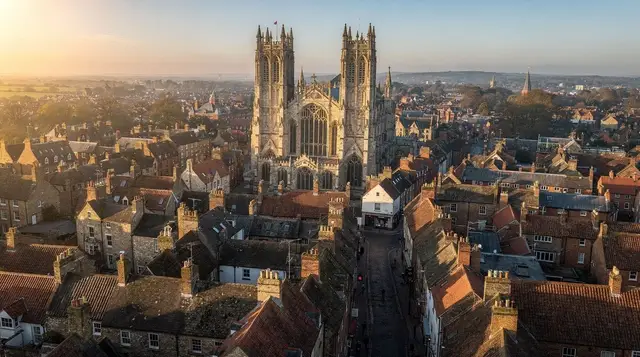
York’s city walls form one of the most complete surviving sets of medieval defensive walls in England, tracing a roughly 2.5-mile loop around the old city that’s entirely walkable, entirely free, and genuinely one of the best ways to get your bearings in York on the first day of a trip. Unlike most of the city’s paid attractions, there’s no ticket, no timed entry and no queue — you simply climb one of the access points and start walking.
| Where | 2.5-mile loop, start at any of the four main bars |
| --- | --- |
| Cost | Free (gatehouse museums a few pounds each) |
| --- | --- |
| Time needed | 90 minutes to 2 hours for the full loop |
| --- | --- |
| Getting there | Bootham Bar is beside York Minster |
| --- | --- |
| Best time | Early morning for light and quiet |
The history of the walls
The current stone walls largely date from the 12th to 14th centuries, built on top of earlier earthwork defences that go back to the Roman and Anglo-Saxon periods — parts of the route follow the line of the original Roman fortress walls, and a section near Museum Gardens still shows the Multangular Tower, a genuine surviving fragment of Roman stonework. Over the following centuries the walls were expanded, repaired and occasionally threatened with demolition (a 19th-century campaign to tear them down for road improvements was narrowly defeated by local preservation efforts), leaving York with one of the most intact circuits of medieval town walls anywhere in England.
For the deeper history of the earlier defences these walls replaced or incorporated, see the Roman York guide and the medieval York guide.
The four main bars (gatehouses)
York’s walls are punctuated by several fortified gatehouses, known locally as “bars,” each with its own character and history — for the fuller story of each one, see the York city gates and bars guide. Bootham Bar, right beside York Minster, sits on the site of the original Roman fortress’s north-west gate and is the most central starting point for most visitors. Monk Bar is the tallest and most elaborate of the four, with a still-functioning portcullis and a small museum inside dedicated to Richard III, who had strong connections to York.
Walmgate Bar is the only one of the four to retain its barbican — an outer defensive structure — intact, giving a rare sense of what a fully defended medieval gatehouse actually looked like. Micklegate Bar was historically the most significant, used as the traditional entrance for monarchs arriving in the city and, less pleasantly, a site where the severed heads of traitors were once displayed as a warning.
The full route and what you’ll see
Starting at Bootham Bar and heading clockwise, the walls first take you past close-up views of York Minster’s west towers before curving north and east toward Monk Bar, overlooking a mix of residential streets and the River Foss in the distance. Continuing south, the walls pass near Walmgate Bar and its intact barbican before turning west toward the river, where a section of the circuit is actually broken — there’s no wall along the riverside stretch near Skeldergate, so you’ll need to drop down to street level and rejoin further along.
The final stretch toward Micklegate Bar and back around to the station area passes some of the quieter, less-visited sections of the walls, generally with fewer other walkers than the busier Bootham-to-Monk Bar stretch.
How long it takes and where to join
The full circuit is roughly 2.5 miles and takes most people 90 minutes to 2 hours at a relaxed pace with stops for photos and information panels — faster if you’re walking briskly without pausing. You don’t need to do the whole loop in one go: access points at each of the four main bars, plus several smaller staircases along the route, let you join or leave whenever suits your schedule. A popular shorter option is the stretch from Bootham Bar to Monk Bar, which takes in the Minster views and the most architecturally interesting gatehouse in around 30-40 minutes.
Practical notes
The walkway itself is narrow in places — often only wide enough for two people to pass comfortably — and uneven underfoot in older sections, so it’s not ideal for pushchairs or wheelchair users along most of the route, though the ground-level bars and streets below remain fully accessible. Handrails exist on the more exposed drops but the walls do have real height in places, worth keeping in mind with young children who might want to run ahead. The walls close at dusk and occasionally shut sections for repairs after storm damage or ongoing conservation work, so if a specific stretch is essential to your plans, it’s worth checking there are no closures before you set off.
When to walk them
Early morning is genuinely the best time — softer light for photos, far fewer people, and a good way to get oriented before the rest of the city wakes up. The walls can feel crowded on summer weekends, particularly the Bootham Bar to Monk Bar stretch near the Minster, so if you want a quieter experience, either go early or pick one of the less central sections like the Walmgate to Fishergate stretch.
Combining the walk with the rest of your day
The walls intersect with much of what else there is to see in York — you can drop down from Bootham Bar directly to York Minster, or from near Monk Bar into the tangle of medieval lanes known as the Snickelways. If you want a more structured, dedicated version of this walk with additional detail on each stretch, see the complete city walls walk guide, which goes further into route planning for walkers wanting the full circuit as a standalone activity rather than a quick add-on.
For fitting the walls into a wider itinerary, the one-day York itinerary and best things to do in York guide both build the walls in as a low-cost, high-value addition to a first visit.
What makes York’s walls unusual among English cities
Most English cities lost their medieval defensive walls centuries ago, either demolished deliberately to allow urban expansion or simply left to decay and be built over as populations grew beyond their old boundaries. York is a genuine exception, retaining a more complete circuit than almost anywhere else in the country — only Chester’s walls come close in terms of completeness and public walkability. This survival wasn’t inevitable: a 19th-century proposal to demolish sections of the walls for road-widening and general urban “improvement” was seriously debated and only narrowly defeated by a determined local preservation campaign, a reminder that what feels like an obviously valuable heritage asset today was, within relatively recent history, viewed by some as an outdated obstruction to modern progress.
Understanding this near-miss adds a layer of appreciation to a walk that might otherwise feel like simply admiring old stonework.
Walking the walls with different interests in mind
History-focused visitors get the most from lingering at each of the four main bars, reading the interpretation panels in depth and considering paying the small entry fee for Monk Bar’s Richard III museum. Photographers will find the golden hour around sunrise or sunset gives the richest light on the stonework, with the Bootham Bar to Monk Bar stretch offering the most reliably good compositions given the Minster backdrop. Runners and fitness-focused visitors sometimes use quieter early morning stretches of the walls for a scenic loop, though it’s worth being considerate of other walkers on the narrower sections rather than treating the whole circuit as a running track.
Families with children generally do best sticking to shorter, well-populated stretches near the main bars rather than attempting the full circuit in one go, particularly with younger children who may tire of the walking well before the 2.5-mile loop is complete.
Connecting the walls to the rest of York’s history
Walking the full circuit gives a genuinely useful mental map of how York’s medieval city related to its Roman predecessor and its later growth beyond the walls. Sections of the route roughly trace the boundary of the original Roman fortress, visible in fragments like the Multangular Tower near Museum Gardens, while other stretches reflect medieval-era expansion as the city grew beyond its Roman footprint.
Understanding this layered history — Roman fortress, medieval walled city, and the modern York that’s grown up around and beyond both — makes the walk considerably more interesting than simply appreciating old stone for its own sake, and it’s worth reading a little of the medieval York guide or Roman York guide before setting off if you want the walk to click into place as more than just a pleasant stroll.
What to bring
Sensible flat shoes matter here just as much as on the Minster tower climb — the walkway surface varies from smooth modern paving to genuinely uneven medieval stone in older sections, and it’s exposed to whatever weather is happening that day with very little shelter along most of the route. A water bottle is worth carrying if you’re doing the full circuit in warm weather, since there are long stretches between the bars where you won’t pass a shop or café directly on the wall itself.
If you’re bringing a camera specifically for this walk, a lightweight setup is more practical than heavy gear, given how much of the route involves a moving vantage point rather than fixed spots where you’d want to set up and wait for a shot.
If you’d rather have it explained as you walk
Reading panels and guides between stops works fine, but if you want the history of each bar and stretch narrated properly, a guided city highlights walking tour covers much of the same route with a local guide connecting the walls to the wider story of medieval York and Roman York as you go, typically in around 90 minutes.
Frequently asked questions about walking York’s city walls
Do you need tickets to walk York’s city walls?
No, walking the walls themselves is completely free with open access at multiple points around the circuit. Some individual gatehouse museums, like the Richard III exhibition inside Monk Bar, charge a separate small entry fee if you want to go inside rather than just walk past on the wall.
Is the York city walls walk suitable for pushchairs or wheelchairs?
Not really for most of the route — the walkway is narrow and uneven in older sections with steps at several access points. The streets and gatehouses at ground level remain accessible, so you can still see the bars themselves without walking the elevated wall path.
What is the best time of day to walk York’s city walls?
Early morning, both for quieter conditions and better light for photography, particularly along the Bootham Bar to Monk Bar stretch overlooking York Minster. Summer weekend afternoons are the busiest time.
Can you walk the entire loop of York’s city walls?
Almost — the circuit is broken in a couple of short sections, most notably along part of the riverside near Skeldergate, where you’ll need to drop to street level briefly before rejoining the wall further along.
Related guides

York Museum Gardens: a guide to the abbey ruins and grounds
York Museum Gardens explained: the ruined St Mary's Abbey, the Roman Multangular Tower, free access hours and what else sits within the grounds.

Best things to do in York: a ranked, honest guide
The best things to do in York, ranked honestly with real 2026 prices, how long each attraction takes, and which ones are actually worth your time.

York Minster: the complete visitor guide
How to visit York Minster: real 2026 ticket prices, opening hours, the tower climb, the Great East Window and how to skip the worst of the queues.

Clifford's Tower: York Castle's medieval keep
Clifford's Tower explained: its 750-year history, the 2022 rooftop restoration, real 2026 ticket prices and what the view from the top shows you.
Ready to book? Top tours for this guide
We earn a small commission if you book through GetYourGuide or Viator — at no extra cost to you. Every tour is hand-picked and verified.

York: private guided walking tour

York: self-guided walking tour with mobile app

York: daytime sightseeing cruise with live commentary
York: 60-minute happy hour river cruise
York: guided cycling tour