
York Minster: the complete visitor guide
What does it cost to visit York Minster and how long should you spend there?
A standard Minster ticket (nave, quire, Undercroft and Chapter House) runs around £17 for an adult, with the tower climb an extra add-on around £6. Budget 90 minutes for the Minster alone, or half a day if you're also climbing the tower and exploring the Undercroft museum properly.
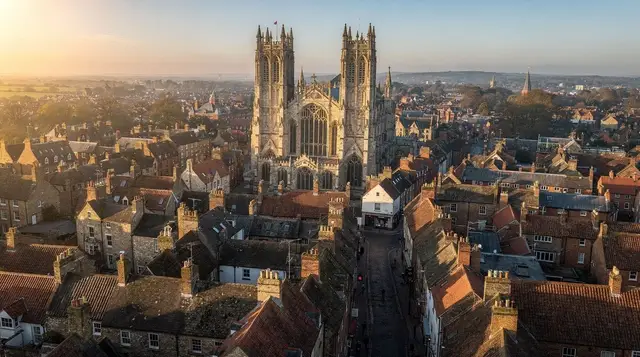
York Minster dominates York’s skyline from almost every angle in the city, and it dominates most people’s first day here too — it’s usually the first thing visitors head for, and for good reason. This is the largest medieval Gothic cathedral in Northern Europe, built over roughly two and a half centuries and finished in 1472, and it’s still a working cathedral rather than a museum piece: services happen daily, and the building is genuinely used, which changes how it feels to walk around. Expect to spend at least 90 minutes here, longer if you’re doing the tower climb or taking your time in the Undercroft.
| Where | Duncombe Place, city centre |
| --- | --- |
| Cost | Around £17 adult, tower climb +£6 |
| --- | --- |
| Time needed | 90 minutes, half a day with the tower |
| --- | --- |
| Best time | Opening (9am) or an hour before last admission |
| --- | --- |
| Free option | Choral Evensong, usually 17:15 weekdays in term time |
What’s included, ticket by ticket
| Ticket | Roughly covers | Good for |
|---|---|---|
| Standard adult (~£17) | Nave, quire, Great East Window, Undercroft, Chapter House | Most first-time visitors |
| --- | --- | --- |
| Tower climb add-on (~£6) | 275-step climb, timed slot | Fit visitors wanting the city view — see the tower guide |
| --- | --- | --- |
| Choral Evensong | Nave and quire during the service | Free, atmospheric, no advance ticket needed |
| --- | --- | --- |
| Guided tour add-on | Standard ticket plus expert commentary | Anyone who wants the history explained, not self-read |
Getting there and when to go
The Minster sits at the top of Duncombe Place, a short walk from Bootham Bar and the top end of the Shambles — pretty much everything in central York is within 10-15 minutes on foot. If you’re staying in York city centre, you can simply walk over; if you’re further out, the park and ride drops you within a 10-minute walk of the west front.
Queues build fastest between 10am and 1pm, especially in July and August, when coach groups and day-trippers overlap. Arriving at opening (usually 9am, check the exact time for your visit day since Sunday mornings are worship-only until early afternoon) is the single best way to avoid a wait and to get photos of the nave without dozens of other visitors in shot. Late afternoon, an hour or so before last admission, is the second-best window — most of the day’s crowds have moved on to lunch or the Shambles by then.
What a ticket actually includes
A standard adult ticket, bought online, runs around £17 and covers the nave, quire, the Great East Window end, the Undercroft museum (which sits below the Minster and covers its Roman, Norman and medieval foundations), and the Chapter House. The Undercroft is easy to skip if you’re short on time, but it’s worth the extra 20-30 minutes: you’re walking over the footprint of a Roman fortress and a Norman cathedral, with excavated remains visible beneath glass floor panels.
The tower climb is a separate add-on, typically around £6 on top of the main ticket, and it needs a timed slot booked in advance — see the dedicated tower climb guide for whether it’s worth it and who should give it a miss. Tickets bought online are usually a little cheaper than paying at the door, and they’re valid for repeat entry within a set period (check the current terms when booking), which is handy if you want to pop back for Evensong on a different day using the same ticket.
A guided tour of York Minster is worth considering if you want the history explained properly rather than working it out from information panels — a good guide will point out details in the stonework and stained glass that are easy to miss on a self-guided visit, and it takes the guesswork out of timing your visit around the crowds.
The Great East Window and the stained glass
The single most impressive thing inside the building is the Great East Window, the largest expanse of medieval stained glass in the world — roughly the size of a tennis court, made around 1405-1408, and telling the story of the beginning and end of the world according to the Book of Revelation. It underwent a major decade-long restoration completed in the 2010s, and the colours are genuinely startling in good light. Try to time your visit for a bright morning if you can; the window faces east, so morning light does it more justice than a grey afternoon.
The Five Sisters Window in the north transept is different in character — five tall lancet windows filled almost entirely with grisaille (grey-toned) glass rather than colour, and it’s the largest surviving expanse of this type of medieval glass anywhere in the world. It’s quieter and less photographed than the Great East Window, which makes the transept a decent spot to pause if the main nave feels busy.
The Chapter House and the Quire
The Chapter House, an octagonal room off the north transept, has no central pillar supporting its roof — an engineering choice that was considered remarkable when it was built and still draws people to stand in the middle and look up. The carved stone canopies above the seating around the walls are covered in small carved faces, animals and grotesques, worth a slow lap rather than a glance.
The Quire, where services are held, sits behind an elaborately carved screen showing statues of English kings from William the Conqueror to Henry VI. If you’re able to time a visit around Choral Evensong (usually 17:15 on weekdays in term time — check the exact schedule since it shifts around school holidays and special services), it’s free to attend and gives you a very different experience of the same space: you sit in the Quire itself rather than viewing it from outside the screen, and the choir fills the whole building with sound in a way that’s hard to overstate.
History in brief
There’s been a church on this site since at least the early 7th century, and the ground beneath the Minster has yielded Roman remains from the legionary fortress that once stood here — you can see some of this layered history in the Roman York guide. The current Gothic building replaced a Norman cathedral and took roughly 250 years to complete, from the early 1200s to 1472, which explains why different sections show different architectural styles as building techniques and fashions changed across the generations of masons who worked on it.
For the fuller story of how the building evolved, see the York Minster history guide, which goes deeper into the construction timeline, the 1984 south transept fire, and the ongoing conservation work that never really stops on a building this old.
Combining a Minster visit with the rest of the day
Most people pair the Minster with a walk along the city walls, which you can join at Bootham Bar right beside the Minster’s west front, or a wander through the tangle of medieval lanes known as the Snickelways, several of which start within a few minutes’ walk. If you’ve got kids in tow and the Minster itself is a lot of standing and looking, the Yorkshire Museum and Museum Gardens are a five-minute walk away and give them somewhere to run around.
For planning a full day or two around the Minster, the one-day York itinerary and two-day York itinerary both build the Minster in as the anchor for a morning, and the first-time York guide has broader advice on sequencing your visit so you’re not backtracking across the city. If you’re deciding what else deserves your time and money, the best things to do in York guide ranks the Minster against everything else in the city.
Honest notes and things to know before you go
The Minster is a working cathedral, which means services occasionally close off sections at short notice — if you have your heart set on the Chapter House or Quire, it’s worth checking the day’s schedule when you arrive rather than assuming full access. Photography is generally allowed in most areas (no flash, no tripods without prior arrangement) but is restricted during services, which is fair enough. Bag checks and airport-style security are standard at the entrance, so allow a few extra minutes if you’re carrying a large rucksack.
The building is enormous and largely unheated in the way a modern space would be, so it can feel noticeably cooler than the street outside even in summer — a light layer is worth carrying regardless of the season. And if you only do one thing here, make it the Great East Window and a slow walk down the nave looking straight up; craning your neck at the vaulted ceiling is, more than any single exhibit, the reason people come back to York Minster more than once.
Photography tips inside the Minster
Tripods generally require prior arrangement with the Minster’s visitor team, but handheld photography is allowed throughout most public areas, flash excluded near the stained glass to protect the pigments. The nave’s west end, looking east down the full length of the building toward the Quire screen, is the classic shot, and it works best mid-morning when light isn’t pouring directly through the west window and blowing out the exposure. For the Great East Window itself, a late morning to early afternoon visit on a clear day gives the richest colour, since the window faces east and catches the sun earlier in the day than you might expect for a building this size.
If you’re visiting with a phone camera rather than anything more capable, the Chapter House’s octagonal ceiling responds surprisingly well to a simple straight-up shot from the centre of the room — it’s one of the more reliably impressive photos casual visitors come away with.
Seasonal considerations
The Minster’s character shifts noticeably across the year. Winter visits, particularly in the run-up to Christmas, bring candlelit carol services and a genuinely atmospheric warmth to the building that contrasts with its cool stone in summer — worth checking the events calendar if you’re visiting in December, since some of these services are ticketed separately and sell out well in advance. Summer brings the longest opening hours and the best natural light for the stained glass, but also the heaviest crowds, particularly from mid-July through August when school holidays across the UK and mainland Europe overlap.
Spring and early autumn tend to offer the best balance: decent light, manageable crowds, and comfortable temperatures for the tower climb if you’re doing it. The JORVIK Viking Festival in February brings a different kind of energy to the whole city, including costumed events that sometimes spill into the area around the Minster, worth factoring in if you’re visiting York specifically for that.
Money-saving tips
Booking online in advance rather than paying on the door is the simplest saving available, typically knocking a few pounds off the standard adult rate. If you’re planning to visit multiple paid attractions in York during your stay, it’s worth comparing the cost of individual tickets against a city-wide multi-attraction pass — see is the York Pass worth it for a genuinely honest breakdown of when these passes pay for themselves and when they don’t, since the answer depends heavily on how many attractions you realistically plan to visit.
Attending Choral Evensong remains the only genuinely free way to experience the building’s interior, and it’s worth treating as a real option rather than a fallback — many visitors who attend by chance end up rating it as a trip highlight precisely because it wasn’t a paid, transactional visit.
Understanding the Minster’s role in the city today
Beyond its role as a visitor attraction, York Minster remains the seat of the Archbishop of York, the second-most senior clergy position in the Church of England after the Archbishop of Canterbury, and it continues to host major civic and national events. This isn’t purely historical trivia — it explains why the building sometimes closes sections at short notice for services, ordinations or civic occasions, and why the atmosphere inside can feel markedly different depending on whether you happen to visit during a quiet weekday afternoon or a day with a scheduled service.
Understanding this dual identity, as both a major tourist attraction and a genuinely active place of worship and civic life, helps set the right expectations before you go: this isn’t a static museum piece, and part of its appeal is precisely that it’s still being used for the purpose it was built for, eight centuries on.
Facilities and practical details
There are toilets and a small shop within the Minster complex, and a café is available for a coffee or light lunch without leaving the building, useful if you’re doing the full visit including the tower and don’t want to lose your place in the day’s plan. There’s no dedicated cloakroom for large bags, so if you’re arriving with luggage — straight from the station, say — it’s worth planning to drop it at your accommodation first, since bag checks at the entrance can be slower with bulky items. For a proper sit-down meal afterwards, the where to eat in York guide has options within a five-minute walk of the west front.
Frequently asked questions about York Minster
What time does York Minster open?
Standard opening is generally around 9am on weekdays and Saturdays, with last admission an hour or so before closing. Sundays are different — the building is reserved for worship until early afternoon, so if you’re visiting on a Sunday, plan your trip for after midday and double-check the exact hours for your date, since they shift with the church calendar and special services.
Is the York Minster tower climb included in the standard ticket?
No. The tower is a separate paid add-on with its own timed entry slot, bookable alongside your main ticket. It’s a genuine 275-step climb with no lift, so it’s not for everyone — see the tower climb guide linked above for a fuller breakdown of who should and shouldn’t do it.
How long does it take to see York Minster properly?
Around 90 minutes if you cover the nave, quire viewing area, Undercroft and Chapter House at a reasonable pace. Add 45-60 minutes if you’re also doing the tower climb, and longer still if you want to linger over the stained glass or attend Evensong.
Can I bring a pushchair or wheelchair into York Minster?
Yes, the main ground-floor areas are accessible, with a ramped entrance and lift access to the Undercroft. The tower is not accessible under any circumstances, since the 275 spiral steps have no alternative route.
Is there a dress code for York Minster?
No formal dress code for general visits, though modest dress (covered shoulders, no swimwear) is appreciated and sometimes requested if you’re attending a service. It’s a place of worship first and a visitor attraction second, which is worth keeping in mind if you’re visiting straight off a hot afternoon in shorts and flip-flops.
Related guides

Best things to do in York: a ranked, honest guide
The best things to do in York, ranked honestly with real 2026 prices, how long each attraction takes, and which ones are actually worth your time.

Clifford's Tower: York Castle's medieval keep
Clifford's Tower explained: its 750-year history, the 2022 rooftop restoration, real 2026 ticket prices and what the view from the top shows you.

JORVIK Viking Centre: what to expect and how to visit
JORVIK Viking Centre explained: the Coppergate dig behind it, what the ride-through experience covers, real 2026 prices and how to skip the queue.

York Castle Museum: a guide to Kirkgate and beyond
York Castle Museum explained: the Kirkgate Victorian street, the former prison cells, real 2026 prices and how much time to give it.
Ready to book? Top tours for this guide
We earn a small commission if you book through GetYourGuide or Viator — at no extra cost to you. Every tour is hand-picked and verified.

York: private guided walking tour

York: self-guided walking tour with mobile app

York: daytime sightseeing cruise with live commentary
York: 60-minute happy hour river cruise
York: guided cycling tour