York city centre
The walled core of York, from Bootham Bar to Micklegate — how the streets fit together, what's actually inside the walls, and how to navigate it on foot.
Quick facts
Top tours and experiences
We earn a small commission if you book through GetYourGuide or Viator — at no extra cost to you. Every tour is hand-picked and verified.


The walled centre of York is compact enough to cross in under twenty minutes on foot, but confusing enough on first arrival that a bit of orientation saves real time. This is the area bounded by the city walls — everything most visitors mean when they say “York.”
| Where | Walled core of York, roughly oval, 3.4km of walls |
| --- | --- |
| Time needed | Half a day to orient, a full day to explore properly |
| --- | --- |
| Cost | Free to walk and orient; paid attractions inside vary |
| --- | --- |
| Getting around | Entirely on foot — no bus needed |
| --- | --- |
| Best time | Early morning for quiet streets, any season for the walls |
Getting your bearings
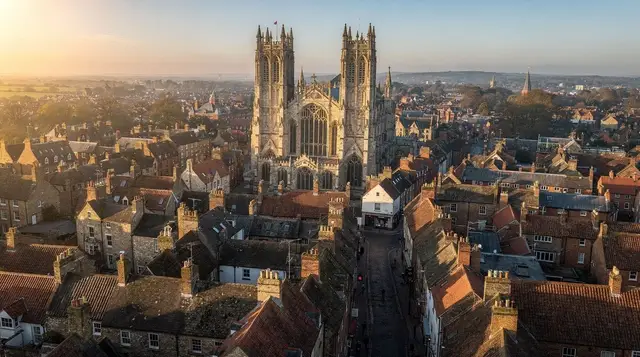
York’s city centre sits inside a roughly oval circuit of medieval walls, entered through four main “bars” (gatehouses): Bootham Bar to the north, Monk Bar to the northeast, Walmgate Bar to the southeast, and Micklegate Bar to the southwest, historically the ceremonial entrance used by monarchs. The River Ouse cuts through the middle, dividing the centre roughly in two, with most of the major sights — York Minster, the Shambles, the Shambles Market — clustered on the eastern side. The railway station sits just outside the walls to the west, a five-to-ten-minute walk from the centre depending on your destination inside.
Street names here can throw people: in York, “gate” means street (a Viking-era holdover — “gata” in Old Norse), while “bar” means gate. So Coppergate and Stonegate are streets, while Micklegate Bar and Monk Bar are the actual gateways through the walls. Once that clicks, the map makes considerably more sense.
The city walls walk
Walking the full circuit of the walls takes around two hours at an easy pace, though most visitors do sections rather than the whole loop. The stretch from Bootham Bar to Monk Bar is the most popular, passing directly behind York Minster with good views down into the Dean’s Park gardens. It’s free to walk, open from around 8am to dusk, and gives a genuinely different perspective on the city than street level — you’re looking down into gardens, over rooftops, and along the original Roman-era fortification line in places. The full city walls walk guide breaks the route into manageable sections if you don’t want to commit to the whole loop in one go.
What’s actually inside the walls
Within this compact area sits nearly everything associated with a York visit: York Minster and its close, the Shambles and the wider tangle of snickelways (the local term for York’s narrow medieval alleyways), the Shambles Market, Clifford’s Tower, York Castle Museum, and most of the city’s independent shops, pubs and restaurants. The National Railway Museum is a notable exception — it sits just outside the walls near the station, a five-minute walk from Lendal Bridge.
Micklegate, running up from Micklegate Bar toward Ouse Bridge, has historically been the city’s pub and nightlife street, while Stonegate — one of the oldest streets in York, still with visible Roman paving beneath it in places — is now largely upmarket shopping. Petergate, running past the Minster, mixes both.
Navigating without getting lost (or embracing it)
The layout genuinely rewards wandering. York’s medieval street plan wasn’t built on a grid, and getting mildly lost in the snickelways between Stonegate and the Shambles is part of the experience rather than a problem to solve — nothing inside the walls is more than fifteen minutes from anything else, so a wrong turn rarely costs much time. That said, York Minster’s towers are visible from most of the eastern half of the centre and work as a reliable landmark if you need to reorient.
Free walking is genuinely the only way to move around inside the walls — there’s no meaningful bus network within the centre, and most streets are pedestrianised or too narrow for regular traffic during the day. If you’re staying inside the walls, factor that into luggage planning: taxis can drop you near your accommodation but often can’t pull up directly outside on the narrowest streets.
Crowds by area and time
The Shambles and the immediate area around the Minster get busiest between 11am and 4pm, particularly with coach tour groups moving through as a block. Micklegate and the area toward the river tend to stay quieter during the day and pick up in the evening instead. If you want photos of the Shambles without crowds, before 9am is close to essential in summer.
Eating and shopping inside the walls
Stonegate and the Shambles areas trend toward tourist-priced options; better value and often better food sits a few streets over on Fossgate, Walmgate and Micklegate. Where to eat in York and best pubs in York both point toward these quieter streets more than the main tourist routes. For gifts and antiques rather than souvenir shops, the area around antiques and vintage York covers the better options, largely away from the Shambles itself.
The snickelways in detail
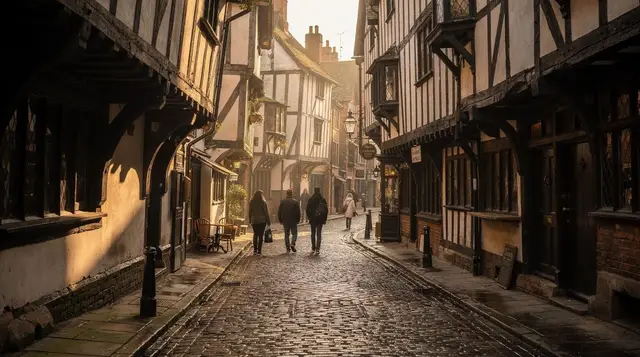
York’s snickelways — a term coined by local author Mark Jones in a 1983 book cataloguing them, now firmly part of the city’s vocabulary — are the narrow medieval alleys threading between the main streets, many barely wide enough for two people to pass. Lund’s Court (still signposted by its older name, Mad Alice Lane, after a woman reputedly hanged for witchcraft nearby), Nether Hornpot Lane and Finkle Street are among the more atmospheric, and walking a handful of them strung together is arguably a better way to feel York’s medieval layout than the more famous Shambles alone, precisely because they see a fraction of the foot traffic.
Most connect the main shopping streets to quieter residential lanes, so following one usually leads somewhere useful rather than being a dead end. The snickelways of York guide maps a specific route linking several together.
Getting oriented with a guide
A self-guided app or a short guided walking tour is a genuinely efficient way to get your bearings on arrival, particularly if you’re short on time and don’t want to spend your first hour figuring out street names and layout by trial and error.
Try a self-guided York walking tour appFor a more traditional option with a local guide who can point out details you’d otherwise walk straight past, a city highlights walking tour covers the core streets and Minster area in around 90 minutes to two hours.
Book a York city highlights walking tourWhere the centre feels different by day and night
By day, the centre runs on tourist footfall — shops, cafés and attractions open from around 9am, with the Shambles and Minster area busiest from mid-morning. By early evening, once shops close, the character shifts: the historic pubs along Micklegate and around Ouse Bridge fill up, restaurants on Fossgate and Walmgate see their dinner trade, and the ghost walk operators gather groups at set meeting points around the Minster and King’s Square. Late at night, particularly on weekends, Micklegate in particular gets a livelier, more studenty crowd than its daytime tourist character suggests — worth knowing if you’re staying nearby and want quiet evenings.
York by night covers the evening side of the centre in more depth.
Accessibility around the centre
The centre’s cobbled streets — the Shambles, much of Stonegate, and sections around the Minster — are genuinely difficult terrain for wheelchairs, prams and anyone with mobility difficulties. Flatter, paved alternatives exist: Parliament Street, Coney Street and the main route from the station toward the Minster via Museum Street are considerably easier going. The city walls have step access at every entry point and aren’t wheelchair accessible at all. Accessible York covers step-free routes and attraction-by-attraction accessibility in more detail than a general orientation guide can.
A practical half-day route
Enter at Bootham Bar, walk the wall section to Monk Bar (about 20 minutes), descend into the Minster area, cut through to the Shambles and Shambles Market, then loop down toward Coppergate and Clifford’s Tower before finishing along the river back toward the station. That covers the essential geography of the centre in around three hours without rushing, and works as a solid orientation before committing to specific paid attractions on a longer stay. It also pairs well with the one day in York itinerary if you’re working with limited time, or the fuller two days in York itinerary if you have more room to slow down.
Street names and what they tell you
Beyond “gate” meaning street, several other names hint at York’s Viking and medieval past if you know what to look for. Coppergate (“street of the cup-makers”) sits near the site of major Viking-age archaeological digs that uncovered the finds now displayed at JORVIK. Goodramgate, Fossgate and Pavement each preserve older trade or geographic associations, and the Bars themselves (Bootham, Monk, Walmgate, Micklegate) were named for what lay beyond them — Bootham Bar faced the Roman road north, Walmgate Bar the road toward Hull. None of this is essential to enjoying a walk through the centre, but it adds a layer of context that turns an aimless wander into something closer to reading the city.
Frequently asked questions about York city centre
How long does it take to walk across York city centre?
Roughly 15-20 minutes edge to edge at a normal pace, though allow longer if you’re stopping at shops or navigating around midday crowds near the Shambles.
Do I need a map to find my way around York’s old streets?
A phone map helps for specific addresses, but the centre is small enough that getting briefly lost rarely costs more than a few minutes — the Minster towers are visible from most points as a landmark.
Is York city centre suitable for wheelchairs and pushchairs?
Cobbled streets in the oldest sections (the Shambles especially) are uneven and can be difficult; the wall walk itself has steps at several points and is not fully accessible. Pedestrianised main streets like Coney Street and Parliament Street are flatter and easier going.
Where’s the best place to start a first visit to York’s centre?
Bootham Bar, near the Minster, gives immediate access to both the cathedral and a walls walk section, and sits a reasonable walk from the station — a natural starting point for orientation.
Are cars allowed inside York’s city walls?
Most of the historic core is pedestrianised or access-restricted during the day; drivers should use the park and ride system on the ring road rather than attempting to drive into the centre.