Malton
A market town that rebranded itself as Yorkshire's food capital, with a food court, monthly markets and Castle Howard nearby.
Quick facts
Top tours and experiences
We earn a small commission if you book through GetYourGuide or Viator — at no extra cost to you. Every tour is hand-picked and verified.


Malton has spent the last decade or so deliberately rebuilding its identity around food, and it’s worked well enough that the town now calls itself, without much argument from anyone, Yorkshire’s food capital. It’s not a place with a single headline attraction — there’s no castle or cathedral to build a visit around — but for anyone who takes eating seriously, it’s one of the more rewarding smaller towns in this part of Yorkshire, and it sits close enough to Castle Howard to make an easy combined day out.
| Where | Howardian Hills, around 25 minutes by direct train from York |
| --- | --- |
| Cost | Free to wander; food and market purchases cost as much as you make them |
| --- | --- |
| Time needed | Half a day, or a full day combined with Castle Howard |
| --- | --- |
| Getting there | Direct train from York toward Scarborough |
| --- | --- |
| Best time | May for the Food Lovers Festival; Saturdays year-round for the market |
Getting there
Malton has a direct train service from York, taking around 25 minutes on the line toward Scarborough — one of the more convenient train connections covered in this guide, with regular services throughout the day. By car, it’s a similar journey via the A64, and it works well as a stop-off if you’re driving to or from Castle Howard, Scarborough or the North York Moors, since it sits roughly on the route between York and the coast — see the day trips from York by car guide for wider route planning.
The Talbot Yard Food Court
The centre of Malton’s food reputation is Talbot Yard, a converted stable yard behind the Talbot Hotel that’s been filled with small, independent food producers rather than a conventional row of shops. Expect to find an artisan bakery, a coffee roaster, an ice cream maker (Groovy Moo, a genuine local success story that’s since expanded beyond Malton), a chocolatier and a handful of other specialist producers, most of them small enough that you can watch or ask about the process rather than just buying from a counter. It’s a good spot for an hour of grazing rather than a sit-down meal — buy a coffee from one unit, a pastry from another, and wander.
The markets
Malton’s Saturday market, held in the town’s market place, is the main weekly event — a proper general market with fresh produce, local meat and fish, and a scattering of crafts and household stalls, busier and more traditional than many town markets that have thinned out elsewhere in England. The town also holds a livestock market on Tuesdays, a genuine working agricultural market rather than a tourist spectacle — worth knowing about if you’re interested in seeing a slice of rural Yorkshire life that isn’t staged for visitors, though it’s a functional trading event rather than something set up for browsing.
Once a year, usually in May, the Malton Food Lovers Festival takes over the town centre with stalls from producers across Yorkshire, cooking demonstrations and a noticeably larger crowd than a normal weekend — worth checking the exact dates if food is the main reason you’re visiting, since timing a trip around the festival significantly changes what’s on offer.
The Fitzwilliam Malton Estate and town regeneration
Much of Malton’s transformation over the past fifteen years has been driven by the Fitzwilliam Malton Estate, the local landowning family, who’ve deliberately curated the mix of independent shops and food businesses that now occupy the town centre rather than leaving it to chain retailers. The result is a high street that feels distinctly different from many small English market towns — more butchers, delis and independent cafés than betting shops and charity shops, which is unusual enough to be worth noting. It’s a genuine, ongoing regeneration effort rather than a one-off marketing push, and the town centre has a noticeably more prosperous, curated feel than its size would otherwise suggest.
It’s a useful contrast to Thirsk, a similarly sized North Yorkshire market town that’s built its visitor identity around literary history rather than food.
Eden Camp Modern History Theme Museum
On the edge of town, Eden Camp is a genuinely unusual museum built inside a former World War II prisoner-of-war camp, using the original wooden huts to house exhibitions on the Blitz, rationing, the Home Front and various aspects of 20th-century British history through immersive, sometimes theatrical displays rather than conventional glass cases. It’s a bigger draw for families and history enthusiasts than for a casual visitor with limited time, and it takes 2-3 hours to see properly, so factor that in if you’re trying to combine it with the town centre and Castle Howard in a single day — realistically, pick two of the three rather than trying to rush all of them.
Malton Museum and the Roman connection
Malton’s history goes back further than its recent food-town rebrand suggests: the town sits on the site of Derventio, a Roman fort and civilian settlement guarding a crossing of the River Derwent, and excavated finds from the site — pottery, coins, tools — are held at the small Malton Museum in the town centre. It’s a modest collection rather than a major archaeological attraction, but worth 20-30 minutes if you’re interested in how far back the town’s history as a trading and market centre actually extends; Malton’s position on the Derwent has made it a natural stopping and trading point for close to two thousand years, long before the food producers of Talbot Yard arrived.
Combining Malton with Castle Howard
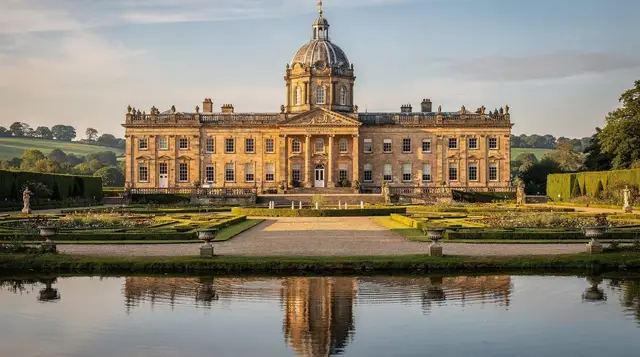
The two make one of the more natural combined day trips in this part of Yorkshire, since Malton is close enough for a leisurely morning of markets and food before an afternoon at the house and grounds. If you’d rather secure your Castle Howard entry before travelling, especially in peak season when the house itself can have timed slots, book a Castle Howard house and grounds ticket in advance, or opt for a grounds-only ticket if you’re more interested in the gardens and less in the interior. Either way, plan the taxi leg from Malton station to Castle Howard ahead of time rather than assuming one will be waiting.
New Malton and Old Malton
The town is technically split into two parts: New Malton, the main town centre with the market place and Talbot Yard, and Old Malton, a smaller, older settlement about a mile to the north, home to the Priory Church of St Mary — the surviving remnant of a 12th-century Gilbertine priory, one of relatively few examples of that particular monastic order’s architecture left in England. It’s a quieter, more residential area than the main town centre, worth a short detour if you have time and an interest in medieval religious history, though most day-trippers focused on food and markets stick to New Malton.
Where to eat
Beyond Talbot Yard, Malton has a genuinely strong spread of independent cafés, delis and restaurants along its main streets — this is a town where “where should I eat” has multiple good answers rather than one obvious default, which is unusual for a town this size. If you’re comparing it to York’s food scene, the where to eat in York guide and the best restaurants in York by budget guide cover the city equivalent, but Malton’s food identity is more artisan-producer-focused than restaurant-focused — it’s a better town for grazing and browsing than for a formal sit-down meal in most cases, though a handful of proper restaurants do exist.
The wider Howardian Hills
Malton sits at the edge of the Howardian Hills, a smaller and less-visited National Landscape (formerly Area of Outstanding Natural Beauty) than the North York Moors or Yorkshire Dales, but genuinely attractive in its own quieter way — rolling farmland, small woods and a scattering of villages between Malton and Castle Howard. It’s not a hiking destination in the way the Dales or Moors are, but a short drive or a longer walk through the surrounding countryside rewards anyone who wants to see a gentler, more agricultural side of North Yorkshire than the region’s headline landscapes typically offer.
Getting around without a car
If you’re relying on trains, Malton’s town centre, market place and Talbot Yard are all within a comfortable walk of the railway station — realistically 5-10 minutes to the market place and slightly further to reach the edges of the food court. This makes Malton one of the easier stops in this guide for visitors without a car, in contrast to Castle Howard, which requires a taxi or organised tour from the station. If you’re planning a car-free day combining both, build in extra time for arranging the Castle Howard leg rather than assuming a seamless connection.
Practical notes
Malton is small and easily walkable — the train station, market place and Talbot Yard are all within 10-15 minutes of each other on foot. It’s not a destination that needs a full day on its own; most visitors combine it with Castle Howard, about 15 minutes away by car, or treat it as a stop on the way to or from the coast. If you’re relying on public transport and want to see Castle Howard the same day, you’ll need a taxi for the final leg from Malton, since there’s no direct bus connection between the two. The how many days in York guide can help with deciding whether a Malton stop fits your overall itinerary.
See the Malton food town guide for a more detailed food-focused route through Talbot Yard and the town centre, and the Castle Howard day trip guide for combining both destinations in a single day from York.
Malton’s brewing and drinks scene
Beyond the food producers, Malton has quietly built a reputation as a brewing town too — several breweries, including a well-known regional name, operate in and around the town, and a handful of taprooms and bottle shops in the centre stock a genuinely good range of local beer alongside the artisan food at Talbot Yard. It’s not marketed quite as loudly as the food side of Malton’s identity, but for anyone building a food-and-drink-focused day, it’s worth a stop, particularly if you’re not driving onward to Castle Howard afterwards.
Frequently asked questions about Malton
How long does it take to get from York to Malton?
Around 25 minutes by direct train, with regular services throughout the day on the line toward Scarborough.
What is Talbot Yard?
A converted stable yard behind the Talbot Hotel in Malton, now home to a cluster of independent food producers — a bakery, ice cream maker, chocolatier, coffee roaster and others — better suited to grazing between units than a sit-down meal.
Can I visit Malton and Castle Howard in one day?
Yes, easily — they’re about 15 minutes apart by car. If you’re not driving, you’ll need a taxi for the connection, since there’s no direct bus or train link between the two.
When is Malton’s main market day?
Saturday is the main general market day. A separate livestock market runs on Tuesdays, aimed at agricultural trading rather than visitor browsing.
Is Eden Camp worth visiting?
If you’re interested in 20th-century British social history, yes — it’s a genuinely unusual museum built in original WWII prisoner-of-war camp huts. It takes 2-3 hours to see properly, so it’s a significant time commitment if you’re also trying to fit in the town centre and Castle Howard.
Is Malton worth a special trip, or only as an add-on to Castle Howard?
It depends on your interests. For food-focused visitors, Malton is worth visiting in its own right. For most other visitors, it works best as a combined stop with Castle Howard or as a lunch break on the way to or from the coast.