Ripon and Fountains Abbey
England's largest monastic ruin, a Georgian water garden and a cathedral city with a thousand-year nightly tradition, near Harrogate.
Quick facts
Top tours and experiences
We earn a small commission if you book through GetYourGuide or Viator — at no extra cost to you. Every tour is hand-picked and verified.


Ripon is a small, quiet cathedral city that most visitors only pass through on their way to Fountains Abbey, and that’s a mistake worth correcting — the city has its own genuine curiosities, and the abbey and its water garden next door are together one of the best half-day-plus outings in Yorkshire, monastic ruin and landscaped Georgian garden rolled into a single National Trust ticket.
| Where | Harrogate-Nidderdale area, around 40 minutes by car from York |
| --- | --- |
| Cost | National Trust entry for Fountains Abbey and Studley Royal; free to walk Ripon itself |
| --- | --- |
| Time needed | Half a day for Ripon, a full day with the abbey and water garden |
| --- | --- |
| Getting there | No train station; drive, or train to Harrogate plus a bus |
| --- | --- |
| Best time | April to October for the gardens; year-round for the abbey ruins |
Getting there
Ripon lost its railway station in the 1967 Beeching cuts and has never had it reinstated, so there’s no direct train option — this is a drive or bus trip rather than a train one. By car it’s around 40 minutes from York via the A1(M) and A61 — see the day trips from York by car guide for wider route planning. Regular bus services connect Ripon to Harrogate (itself a 35-minute train from York), so a train-plus-bus combination works if you don’t have a car, though it adds journey time.
Fountains Abbey itself sits about 4 miles southwest of Ripon, with its own car park; there’s no public transport directly to the abbey gates, so most non-drivers reach it via a taxi from Ripon or as part of an organised tour.
Fountains Abbey
Founded in 1132 by Cistercian monks, Fountains Abbey is the largest monastic ruin in Britain and one of the best-preserved examples of a medieval abbey anywhere in the country — enough of the structure survives (the cellarium, the church tower, the chapter house walls) that you can walk through it and genuinely understand how a working Cistercian monastery was laid out, rather than just admiring isolated fragments. It was dissolved, like every English monastery, under Henry VIII in 1539, and its stone was subsequently sold off and repurposed into local buildings for centuries — a fairly typical fate for English abbeys, but the scale of what survives here is unusual.
The site earned UNESCO World Heritage status jointly with the adjoining Studley Royal estate, and the National Trust, which manages it, has kept the ruins largely unrestored rather than rebuilt — you’re looking at genuine 12th-to-16th-century stonework, weathered and roofless, rather than a reconstruction. Give the abbey itself at least 90 minutes if you want to actually explore the buildings rather than glance at them from the entrance path. If you’re weighing up how many days to give this side of Yorkshire, the how many days in York guide is a useful starting point.
Studley Royal Water Garden
Adjoining the abbey — and included in the same ticket — is Studley Royal, an 18th-century water garden created by John Aislabie and his son William, using the River Skell to build a sequence of ornamental lakes, cascades, statues and follies (including the Temple of Piety and the Octagon Tower) leading the eye toward the abbey ruins in the distance. It’s one of the best-preserved Georgian water gardens in England, and the walk from the water garden through to the abbey — timed so the ruins appear as a dramatic set-piece at the end of a designed vista — is genuinely one of the more impressive pieces of landscape design you’ll see in Yorkshire.
Studley Royal’s deer park, home to red, fallow and sika deer roaming freely across open parkland, is a separate but connected area, popular for a longer walk if you have the time and energy.
Combined, the abbey and water garden site is large — plan for at least half a day, and a full day if you want to properly walk the deer park too. Wear proper shoes; much of the site is grass, gravel paths and uneven ground rather than paved walkways.
Ripon Cathedral and the Saxon crypt
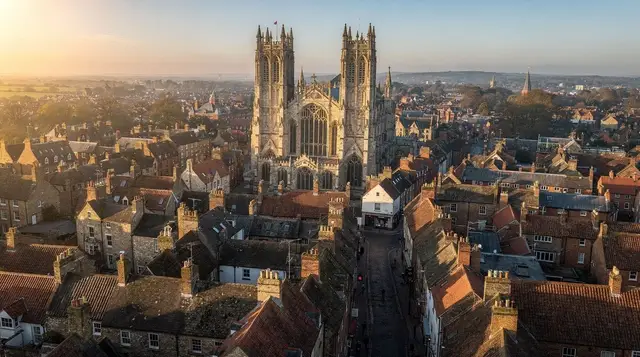
Back in the city, Ripon Cathedral has a claim most visitors don’t expect: beneath the main body of the church lies a genuine Saxon crypt, built around 672 AD by St Wilfrid, making it one of the oldest ecclesiastical structures still standing in England. It’s a small, low, stone chamber — a striking contrast to the Gothic cathedral built up around and above it over the following centuries — and free to visit as part of a cathedral visit (a donation is welcomed). The cathedral itself is worth 30-45 minutes even without a deep interest in architecture; it’s a genuinely handsome building without the crowds of York Minster.
The Ripon Hornblower
Every night at 9pm, without exception and without having missed a single night since the tradition began over a thousand years ago (according to the city, at least — the exact continuity is debated by historians, but the tradition itself is real and long-running), the Ripon Hornblower sounds a horn at each corner of the Market Cross in the city centre, a ceremony rooted in the medieval “setting the watch,” when a horn blast signalled the city’s night watchman had begun his duty and residents could sleep safely.
It’s free, takes about ten minutes, and is a genuinely charming way to end a visit if your timing allows — worth building an evening stop into your schedule if you’re staying in the area rather than day-tripping.
Ripon Racecourse and the wider city
Ripon is also home to a small, well-regarded flat racecourse, one of the prettiest small tracks in the north of England, hosting race meetings through the summer months — a genuinely pleasant reason to plan a visit around a race day if the timing works, with a different, livelier atmosphere than the cathedral and museums suggest. Away from race days, the city’s compact centre around the Market Square and Cathedral has a decent spread of independent cafés and shops, smaller and quieter than Harrogate’s but with a genuine, unhurried market-town feel that some visitors prefer.
Ripon’s other museums
Ripon has an unusually dense cluster of small museums for a city its size, collectively known as the Yorkshire’s Law and Order museums: the Ripon Workhouse Museum, the Prison and Police Museum, and the Courthouse Museum, each covering a different slice of 19th-century justice and welfare history through original buildings and artefacts. None of them are large — each takes 30-60 minutes — but together they’re a genuinely distinctive niche for a city of Ripon’s size, worth an hour or two if the abbey and cathedral haven’t filled your day.
Newby Hall and other nearby houses
If Fountains Abbey and Ripon Cathedral haven’t filled your appetite for grand buildings, Newby Hall, a few miles east of Ripon, is a stately home with formal gardens along the River Ure, notable for its Robert Adam interiors and a substantial collection of classical sculpture assembled during the 18th century — a different flavour of Yorkshire heritage from the ecclesiastical focus of Ripon and Fountains, worth knowing about if you’re building a longer stately-homes-and-gardens trip around this part of North Yorkshire rather than a single stop.
The Cistercian story behind the ruins
Fountains Abbey’s foundation in 1132 came about after a group of Benedictine monks from York’s St Mary’s Abbey broke away in search of a stricter, more austere form of monastic life, settling in this remote, wooded valley on land granted by the Archbishop of York — a genuinely harsh start, with the monks reportedly surviving an early winter on little more than boiled leaves before formally affiliating with the Cistercian order and adopting their disciplined agricultural and architectural model. Over the following four centuries, the abbey grew into one of the wealthiest religious houses in England, built substantially on sheep farming and the wool trade across its extensive land holdings in Yorkshire — a detail that connects directly to the wool wealth that later built Bradford’s Victorian merchant quarters, centuries downstream from the same regional industry.
Understanding that trajectory, from ascetic breakaway community to major economic power, adds useful context to what can otherwise read as simply an attractive ruin.
That wool wealth is also why the abbey’s ruins are as extensive as they are today: a monastery this rich could afford stone construction on a scale most contemporary English religious houses couldn’t match, which is part of why so much survives even after four centuries of quarrying its stone for other buildings following the Dissolution.
Practical notes
If you’re deciding where to stay for a multi-day trip covering this corner of Yorkshire, see the where to stay in York guide. This is a full outing rather than a quick stop if you want to do both the abbey/water garden and Ripon’s city sights properly — realistically a full day if you’re not driving, since bus connections between Ripon and Fountains Abbey are limited. If you’re short on time, prioritise the abbey and water garden over the city; it’s the more significant and more photogenic of the two, and most people rate it the highlight of a visit to this part of Yorkshire.
The site can be genuinely busy on summer weekends and around Christmas (when the abbey runs an illuminated evening trail), so arriving early is worth it if you want quieter photographs of the ruins.
This pairs naturally with a wider Nidderdale trip: Harrogate is about 30-40 minutes away by car, Knaresborough a similar distance, and Brimham Rocks is within reach if you’re driving through the area. See the Fountains Abbey day trip guide for a route from York, and the two-day York, Harrogate and Fountains Abbey itinerary if you want to combine this with a proper stop in Harrogate rather than rushing both in one day.
The day trips from York by car guide also covers how to sequence this area against other car-based day trips.
Frequently asked questions about Ripon and Fountains Abbey
Is there a train station in Ripon?
No — Ripon’s railway station closed in 1967 and has never reopened. The nearest train station is Harrogate, connected to Ripon by bus, or you can drive directly from York in around 40 minutes.
How long should I budget for Fountains Abbey and Studley Royal?
At least half a day for a proper visit covering the abbey ruins and the closest parts of the water garden; a full day if you want to walk the deer park and see everything the site offers. It’s a genuinely large site, not a quick stop.
Are Fountains Abbey and Studley Royal covered by the same ticket?
Yes — they’re a single National Trust site with one entry ticket covering the abbey ruins, the water garden and the deer park, all connected by walking paths.
Is the Ripon Hornblower ceremony free?
Yes, it’s a free nightly ceremony at 9pm at the Market Cross in the city centre, taking about ten minutes. No booking or ticket is required.
Can you visit Fountains Abbey without a car?
It’s possible but awkward — there’s no direct public transport to the abbey gates. Most non-drivers reach Ripon by bus (connecting from Harrogate) and then take a taxi or organised tour for the final leg to the abbey.
Is Ripon Cathedral’s Saxon crypt worth seeing?
Yes, if you’re at all interested in early medieval history — it’s one of the oldest surviving ecclesiastical structures in England, dating to around 672 AD, and stands in striking contrast to the Gothic cathedral built above it centuries later.